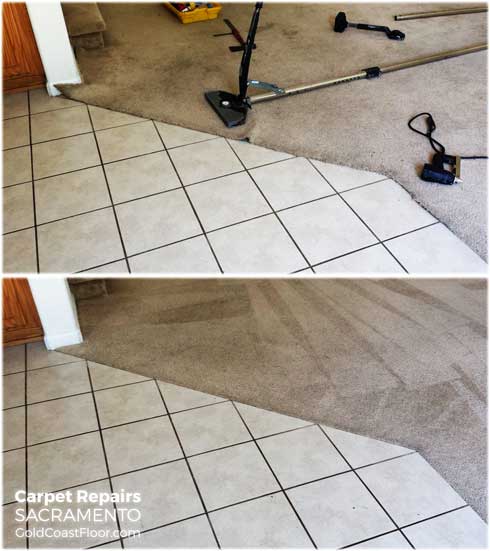
Frequently Asked Questions About Carpet Repair & Stretching
Have questions about carpet repair, pet damage, or carpet stretching?
Below are answers to some of the most common questions we receive from homeowners
throughout Sacramento and surrounding communities.
1. How much does carpet repair cost?
The cost of carpet repair in the Sacramento area depends on the type of damage,
the size of the affected area, and the repair method needed. Small repairs
involving pet damage, holes, or damaged carpet seams may cost less than
larger repairs requiring multiple patches or replacement sections.
As a general example, smaller pet-damaged doorway repairs may range
from $200 to $300. We can provide a more accurate estimate after
reviewing photos of the damaged area or inspecting the carpet.
2. How much does it cost to have carpet stretched?
Carpet stretching costs depend on the size of the room, the condition
of the carpet, and how much furniture needs to be moved. For example,
stretching a typical 300-square-foot living room may range from
$200 to $300. We use professional power-stretching equipment to
remove excess slack and help restore a smooth, tight carpet surface.
Contact Gold Coast Flooring for an estimate based on your project.
3. Can carpet wrinkles be removed without replacing the carpet?
Yes. In many cases, carpet wrinkles, ripples, and loose areas can be
corrected without replacing the carpet. Professional carpet stretching
removes excess slack and re-secures the carpet along the tack strips
around the room. If the carpet and backing are still in good condition,
stretching can be an effective alternative to installing new carpet.
4. Can pet-damaged carpet be repaired?
Yes. Pet damage such as torn carpet, pulled fibers, holes, and damaged
areas near doorways can often be repaired by cutting out the affected
section and installing a matching carpet patch. When possible, we use
extra carpet from a closet or another inconspicuous area of the home.
The goal is to create a repair that blends as naturally as possible
with the surrounding carpet.
5. Can carpet be patched without leftover carpet?
Yes, depending on the carpet and the location of the damage. If you
do not have leftover carpet, we may be able to use a piece from a
closet or another hidden area. This allows us to replace the damaged
section while keeping the repair material consistent with the existing
carpet. The availability of a suitable patch depends on the carpet
condition, color, age, and construction.
6. Can carpet be stretched with furniture in the room?
In many situations, carpet can be stretched without completely
emptying the room. However, furniture may need to be moved to provide
access to the areas being stretched. Smaller items should generally
be removed beforehand, and larger furniture can sometimes be moved
during the job. The amount of furniture moving required depends on
the room layout and the condition of the carpet.
7. How long does professional carpet stretching take?
Most standard carpet stretching jobs can be completed within a few
hours, although larger rooms, multiple rooms, heavy furniture, and
additional repairs can increase the time required. The time needed depends on the size and layout
of the area.
8. Why does carpet develop wrinkles after steam cleaning?
Carpet can sometimes develop temporary ripples after cleaning because
moisture and humidity can affect the carpet fibers and backing.
However, wrinkles that remain after the carpet has dried may indicate
that the carpet has become loose or was not properly stretched during
installation. If the ripples do not go away, professional carpet
stretching may be needed to restore a smooth surface.
9. Is carpet stretching better than replacing carpet?
If your carpet is still in good condition but has developed wrinkles,
ripples, or loose areas, stretching is often a more affordable option
than replacing the entire carpet. Replacement may be necessary when
the carpet is heavily worn, severely damaged, or deteriorating.
We can evaluate the condition of your carpet and help determine
whether repair, stretching, or replacement makes the most sense.
10. Can frayed carpet edges near tile be repaired?
Yes. Frayed or unraveling carpet edges where carpet meets tile,
hardwood, or another flooring surface can often be repaired.
Depending on the condition of the transition, the repair may involve
trimming damaged fibers, securing the carpet edge, or installing
a new transition strip. Properly securing the edge helps create
a cleaner appearance and prevents further unraveling.